
What Is a UUID?
A UUID (Universally Unique Identifier) is a 128-bit identifier that is guaranteed to be unique across space and time. UUIDs are formatted as 32 hexadecimal characters displayed in five groups separated by hyphens: xxxxxxxx-xxxx-xxxx-xxxx-xxxxxxxxxxxx.
For example: 550e8400-e29b-41d4-a716-446655440000
The key advantage of UUIDs is that they can be generated independently by different systems without coordination, and the probability of generating a duplicate is astronomically small — practically zero.
UUIDs are also known by other names in different standards: GUIDs (Globally Unique Identifiers) in Microsoft systems, and sometimes simply "unique IDs" in casual usage.
UUID Versions Explained
The UUID specification defines several versions, each using a different method to generate uniqueness:
UUID v1 (Timestamp-based) Combines the current timestamp with the MAC address of the generating computer. Guarantees uniqueness but reveals the generation time and hardware identity, which can be a privacy concern.
UUID v4 (Random) Generated entirely from random or pseudo-random numbers. This is the most widely used version because it's simple, fast, and doesn't leak any information. The probability of collision is about 1 in 2^122.
UUID v3 and v5 (Name-based) Generated by hashing a namespace identifier with a name. v3 uses MD5 hashing, while v5 uses SHA-1. These produce deterministic UUIDs — the same input always generates the same UUID.
UUID v7 (Time-ordered) A newer version that combines a Unix timestamp with random data. UUIDs are sortable by creation time, making them excellent for database primary keys where ordering matters.
For most applications, UUID v4 is the recommended choice due to its simplicity, randomness, and wide support across programming languages.
When to Use UUIDs
UUIDs are ideal in several scenarios:
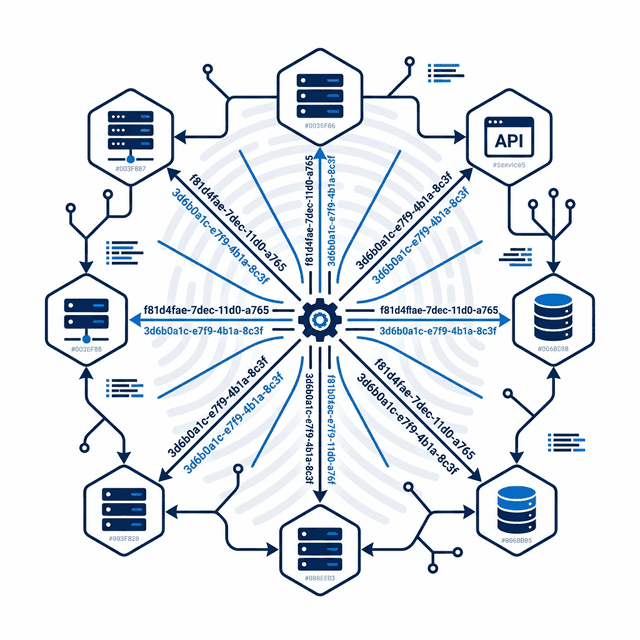
Distributed Systems When multiple servers or services need to generate IDs independently without checking a central database. Microservices architectures heavily rely on UUIDs for this reason.
Database Primary Keys UUIDs prevent ID conflicts when merging databases or replicating data across regions. They also make it impossible for users to guess or enumerate records by ID.
API Resource Identifiers Exposing auto-increment integers in URLs (like /users/42) reveals information about your database. UUIDs like /users/550e8400-e29b-41d4-a716-446655440000 are opaque and non-sequential.
File and Session Identifiers Temporary files, upload identifiers, and session tokens use UUIDs to ensure uniqueness without coordination.
Message Queues and Event Systems Each message or event gets a UUID to enable deduplication, tracking, and idempotent processing.
UUIDs vs. Auto-Increment IDs
Both UUIDs and auto-increment integers are used as primary keys, but they serve different needs:
Auto-Increment Advantages: - Smaller storage size (4-8 bytes vs. 16 bytes) - Better database index performance for sequential inserts - Human-readable and easy to reference
UUID Advantages: - No central coordination needed — generate anywhere, anytime - No information leakage — users can't guess other IDs - Safe for database merging and replication - Can be generated client-side before inserting into the database
When to choose UUIDs: distributed systems, public-facing APIs, multi-tenant applications, and any system where security through obscurity of IDs matters.
When to choose auto-increment: single-database applications, internal systems, and performance-critical workloads with very high insert rates.
Generate UUIDs Online Instantly
Need a UUID right now? DevPik's free UUID Generator creates UUID v4 identifiers instantly in your browser.
Features include: - Generate single or bulk UUIDs - Copy to clipboard with one click - Completely client-side — no data sent to any server - Uppercase and lowercase formatting options
Whether you're setting up database records, testing APIs, or configuring systems, our UUID generator gives you unique identifiers in seconds.